Third-Party vs. Contract Manufacturing in Nutraceuticals: Which is Right for You?

When launching a new supplement brand or expanding an existing product line, choosing the right manufacturing model is your most critical decision. The terms “Third-Party Manufacturing” and “Contract Manufacturing” are often used interchangeably, but in the nutraceutical industry, they mean two very different things.
Understanding the difference between the two can save you time, money, and regulatory headaches. Let’s break it down so you can make the best choice for your business.
Third-Party Manufacturing (White Labeling): You use the manufacturer’s pre-existing, tested formula and put your brand label on it. It’s fast and cost-effective.
Contract Manufacturing: The manufacturer creates a completely custom formula from scratch based on your specific requirements. It offers full control but takes more time and R&D investment.
Table of Contents
1. What is Third-Party Manufacturing?
Also known as “White Labeling” or “Private Labeling,” third-party manufacturing allows you to select a product that has already been formulated, tested, and certified by the manufacturing facility. You simply provide your branding and logo.
- Pros: Extremely fast time-to-market (often 3-4 weeks). No R&D costs. Lower Minimum Order Quantities (MOQs). Pre-approved by regulatory bodies like FSSAI.
- Cons: You cannot change the core ingredients or formula. Your competitors might be selling the exact same formulation under a different brand name.
2. What is Contract Manufacturing?
In Contract Manufacturing (or CDMO – Contract Development and Manufacturing Organization), you hire the facility to bring your unique vision to life. You dictate the ingredients, dosages, flavors, and forms (e.g., converting a powder into a gummy).
- Pros: 100% unique product. You own the proprietary formula. Perfect for targeting highly specific market niches with innovative ingredients.
- Cons: Requires investment in Research & Development (R&D). Longer lead times due to stability testing, sampling, and new FSSAI/FDA approvals. Higher MOQs.
3. Quick Comparison Table
Here is a quick overview of how the two models stack up against each other:
| Feature | Third-Party (White Label) | Contract Manufacturing |
|---|---|---|
| Formulation | Pre-existing / Manufacturer’s | 100% Custom / Yours |
| Time to Market | Fast (3 to 6 Weeks) | Slow (3 to 6 Months due to R&D) |
| R&D Cost | Zero | High (Testing, Sampling, Approvals) |
| MOQ (Minimum Order) | Usually Low to Medium | Usually High |
| Uniqueness | Low (Others may sell the same) | High (Exclusive to your brand) |
4. Which Model Should You Choose?
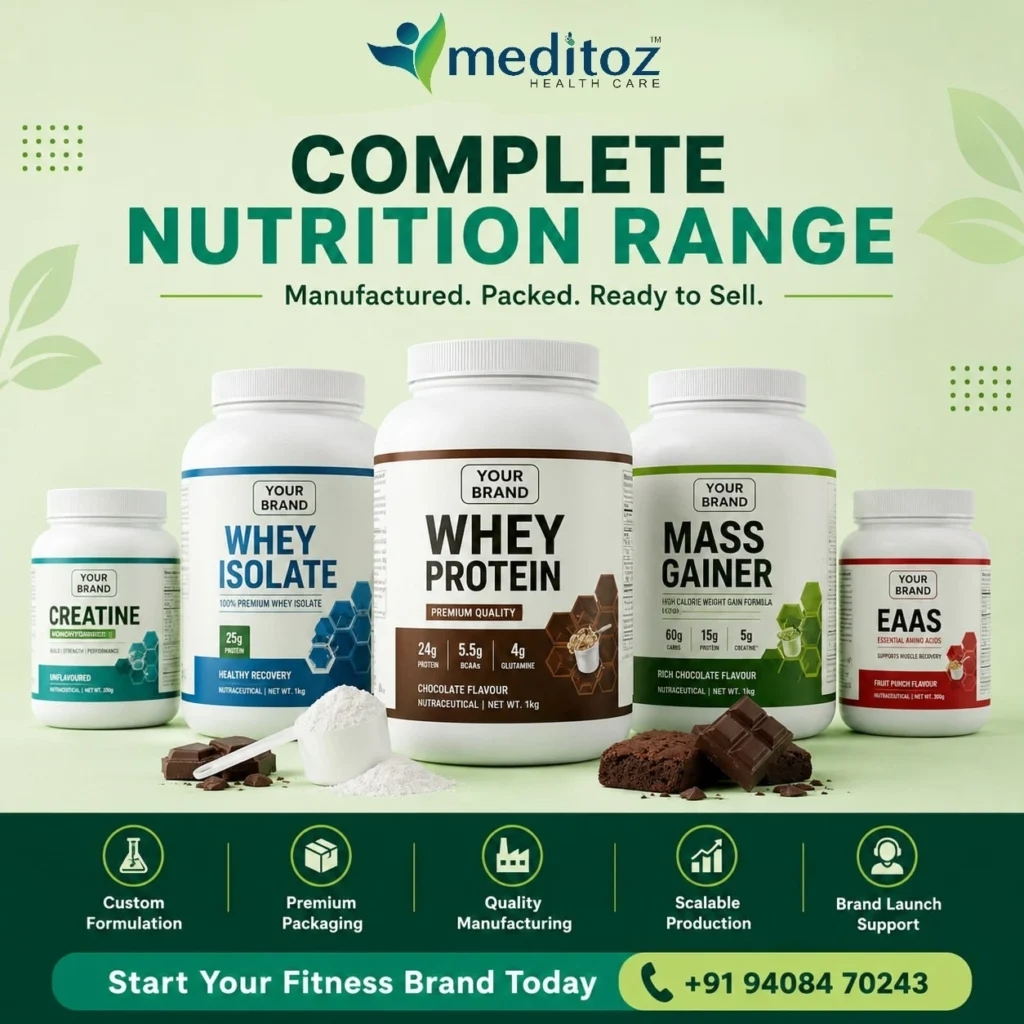
Choose Third-Party Manufacturing if: You are a startup, influencer, or gym owner looking to launch a brand quickly with minimal risk. It’s perfect for standard products like multivitamin capsules, basic whey proteins, or generic immunity boosters.
Choose Contract Manufacturing if: You are an established brand, or you have identified a unique gap in the market that requires a specialized formula (e.g., a vegan, keto-friendly pre-workout with rare adaptogens).
Meditoz Offers Both Solutions
Whether you need a quick-launch white-label product from our 200+ ready formulations, or a custom R&D project, our WHO-GMP certified facility handles it all.
Consult Our Experts FreeFrequently Asked Questions
No, the manufacturer retains ownership of the formulation in a third-party/white-label agreement. You only own your brand name and label design.
Yes, as a fully compliant and certified manufacturer, we assist our contract manufacturing clients with FSSAI approvals and compliance for their custom formulations.